|
|
|
All patterns, pictures and text found on Craftideas.info are property of this website and may be only printed out and used for private or non-commercial purposes, such as school classes. It is not permitted to use the text or pictures on the internet or in any other publication.
|
|
|
|
|
For this project you will need:
- Pine wood 18 mm thick - plywood 8mm thick - basic sawing supplie - acrylic paints in white, grey, soft pink, brown and black - wire - drill with 2.5 mm bit - wood glue - ribbon for the neck
|

|
|
Instructions:
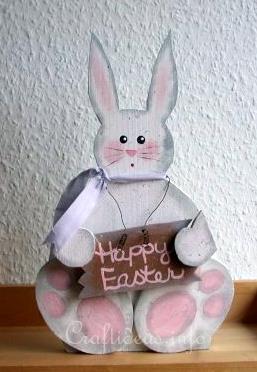
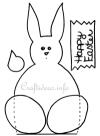
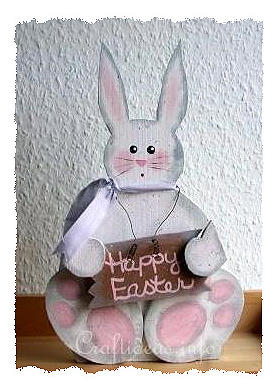
1. The pattern fits perfectly on typing paper. Print out the patterns to the complete size of your typing paper. You need 1 body, 1 sign, 2 feet and 2 hands. 2. Transfer the markings onto the wood. The body is made of the thicker wood and the rest of the parts on the thinner wood. 3. Sand the pieces slightly. 4. Paint the body, hands and feet white and let them dry. 5. Paint the sign brown and also let dry. 6. Drybrush grey on the edges of the white painted pieces. Also on the bunny ears, the cheeks and on the feet, pink is drybrushed on for an extra effect. 7. Use pink paint to write “Happy Easter” on the sign and let the paint dry. Afterwards if you like, you can sprinkle grey paint on the figure using a toothbrush. This gives it yet another extra effect. 8. Make 2 dots for the eyes and a red dot for the mouth. The nose is painted pink. 9. Use a thin paintbrush with only a couple of hairs to do the whiskers on the face with black paint. 10. Drill 2 holes in the top of the sign. Glue the hands onto the sign. They should look like they are holding the sign. 11. Take a piece of wire about 30 cm long and come from the back of the bunny neck and insert the 2 ends in the 2 holes in the sign. 12. Coil the 2 ends of the wire and let them dangle. 13. Glue the feet onto the body. 14. Tie the ribbon around his neck and knot the ribbon. Let the ends hang.
Free Craft Pattern: Easter Bunny
|
|
---------------------------------------------------------------------------------------------------
|
|
|
|
|
How to Saw Wood Out Using a Scroll Saw This tutorial demonstrates cutting along the outside edge of a piece. This example of a leaf hows how to handle sharp angles. Otherwise sawing with a scroll saw is easy and fun. Most pieces you will be cutting have smoother and gradual curves and longer lines to cut. Please work in a well ventilated room when using a scroll saw and avoid inhalating fine dust particles if possible. Wear a paper mask if you can.It is highly recommended to wear safety glasses or goggles to prevent eye injury from flying wood pieces or breaking saw blades. When sawing, avoid putting your fingers too close to the blade. If you have the necessity to remove excess cut away pieces that have fallen off, turn the machine off before doing so. Always use both hands when cutting the wood. Work with larger pieces and when cutting out a small piece, see that you have enough material to get a good grip on. Rather waste a bit more material.
|
|
How to Dry Brush Wood Drybrushing is one of many painting techniques and is easy to learn. It is very effective in shading or highlighting your painted items. Thus giving them a more realistic look. Color plays an important role in dry brushing. You may choose a light contrast for a dark color or a dark contrast for a light color. After practicing on a few pieces, you will discover which colors work best with each other. Consider the item you are painting and what color it is. Important is to dry brush the item with a contrast color and yet the contrast color should also enhance the color of the item you are painting. For example, let us choose the color white. An obvious contrast would be a darker shade. Depending on what you are painting, a shade such as light brown, grey, blue look well on white. On the other hand the color black can only be shaded with a lighter color. You may choose grey or white. When painting with other colors, you may choose lighter or darker shades. For example the color green can be shaded with a darker hue or a lighter hue depending on the effect you would like to create. Important is to experiment. The more you practice, the more secure you will feel about shading and highlighting. Not only can you dry brush wood but also plaster of Paris castings, pappmaché boxes, and other painted items.
|
|
|
|
|
|
|
|
|
Next Craft >>> Large Wooden Bunny with Carrots
|
|
|